The Individuals with Disabilities Education Act (IDEA) is a law ensuring services to children with disabilities throughout the nation. IDEA governs how states and public agencies provide early intervention, special education and related services to eligible infants, toddlers, children and youth with disabilities.
 Congress said this: “Disability is a natural part of the human experience and in no way diminishes the right of individuals to participate in or contribute to society. Improving educational results for children with disabilities is an essential element of our national policy of ensuring equality of opportunity, full participation, independent living, and economic self-sufficiency for individuals with disabilities.”
How did it all begin? On November 29, 1975, the passage of the Education for All Handicapped Children Act, now known as the Individuals with Disabilities Education Act (IDEA), guaranteed access to a free, appropriate, public education (FAPE) in the least restrictive environment (LRE) to every child with a disability.
The current, reauthorized Individuals with Disabilities Education Act (IDEA) was signed into law on December 3, 2004, by President George W. Bush.
Infants and toddlers with disabilities (birth – age 2) and their families receive early intervention services under IDEA Part C. Children and youth (ages 3 – 21) receive special education and related services under IDEA Part B.
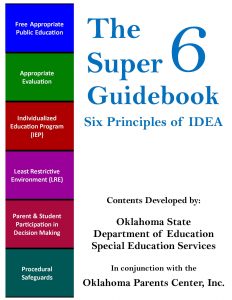 The Oklahoma State Department of Education – Special Education Services (OSDE-SES) along with the Oklahoma Parents Center, Inc. (OPC), Oklahoma’s only statewide Parent Training and Information Center (PTI) authorized in Part D of the Individuals with Disabilities Education Act (IDEA), have developed The Super 6 Guidebook: The Six Principles of IDEA to help you understand your rights as the parent of a child who has been referred or identified as having a disability. Oklahoma is committed to providing guidance and support in order to promote excellence in education for children with disabilities and their parents.
IDEA has four distinct sections: Sections A, B, C and D.
Part A of IDEA: Lays out the basic foundation for the rest of the Act.
Part B of IDEA: Lays out the educational guidelines for school children 3-21 years of age. IDEA provides financial support for state and local school districts. To receive funding, school districts must comply with 6 main principles set out by IDEA:
1) Every child with a disability is entitled to a free and appropriate public education (FAPE).
2) Children are entitled to an evaluation in all areas related to the suspected disability.
3) An Individualized Education Program (IEP) will be developed.
4) Educational services must be provided in the least restrictive environment (LRE).
5) Input of the child and their parents must be taken into account in the education process.
6) Parents have the right under IDEA to question their child’s program plan (due process).
Part C of IDEA: Provides guidelines concerning the funding and services to be provided to children from birth through 3 years of age.
Part D of IDEA: Describes national activities to improve the education of children with disabilities. These activities include grants to improve the education and transitional services provided to students with disabilities. In addition, this section provides resources to support programs, projects and activities which contribute positive results for children with disabilities (IDEA, 1997).
We are pleased to connect you with these resources produced by NICHCY and located at the Center for Parent Information and Resources website:
- Summaries of IDEA’s requirements, which shape what school systems do;
- IDEA itself—to read IDEA’s exact words, you can either download a copy of the law and its regulations, or read them here online;
- Guidance on IDEA from the Office of Special Education Programs at the U.S. Department of Education; and
- Training materials on IDEA that you can use to fully inform yourself and others.
Summaries:
If you’re looking for summaries of what the law requires (rather than its word-for-word statute or regulations), let us point you to two other major sections of our website:
Services for babies and toddlers to the third birthday (Part C of IDEA)
http://www.parentcenterhub.org/repository/babies/
Services for school-aged children, including preschoolers (Part B of IDEA)
http://www.parentcenterhub.org/schoolage/
IDEA Itself:
To read IDEA’s verbatim language can be a big help in understanding why local practices in schools and early childhood settings are as they are. Here is the place to connect with that language. Use the links below to explore the actual words of our nation’s special education law.
Get a Copy of IDEA
Does your desk need a full copy of IDEA or its implementing regulations? Here’s where!
Part C of IDEA: Early Intervention for Babies and Toddlers
Under IDEA Part C, infants and toddlers with disabilities (birth-3) and their families receive early intervention services.
Part B of IDEA: Services for School-Aged Children
Children and youth (ages 3-22) receive special education and related services under Part B of IDEA. Find out all about this extremely critical part of the law.
Guidance on IDEA:
The Office of Special Education Programs (OSEP) at the U.S. Department of Education regularly provides guidance to the field on IDEA. All are intended to clarify elements of the law and its regulations, and are an important part of understanding IDEA and how to implement it. To connect with this federal guidance, visit:
https://www2.ed.gov/policy/speced/guid/idea/memosdcltrs/index.html
Training Materials on IDEA:
If you’re a trainer or advocate who’d like to tell others about IDEA, or find materials to become fully informed yourself—including all those pesky little details—then visit the training curriculum on IDEA 2004 offered here on the CPIR’s website. The training curriculum is divided into 2 parts:
Training materials for Part B (School-aged children)
Building the Legacy / Construyendo el Legado for Part B gives you 19 training modules in English and 8 in Spanish covering the major topics for school-aged children within IDEA 2004. Materials for each module include: a slideshow presentation, a trainer’s guide, handouts for participants, and supplemental resources for trainers. You can use these materials to inform yourself or to train others.
Training materials for Part C (Babies and toddlers to the 3rd birthday)
This part of the training curriculum is based on the final Part C regulations released in September 2011. Materials for each module include: a slideshow presentation, handouts for participants, and a detailed trainer’s guide. You can use these materials to inform yourself or to train others.